Do Subagents Actually Save Money?
Across over 5,000 coding agent runs and a dozen orchestration strategies, we found that subagents can cut a frontier agent’s costs, but the savings they appear to deliver and the savings they actually deliver turn out to be very different numbers. Without the right instruction prompts, they can make agents costlier, slower, and obsessive.
By Jonathan Sakunkoo and Anand Avati
Apparent saving
28.8%
What Fable with Sonnet subagents appeared to save
Real saving
1.7%
What it actually saved
Subagent hype
Recently, subagents have sparked widespread enthusiasm among many engineers building coding agents. Many engineers have shown faith that splitting the work and handing the easy parts to a cheaper model would lead to lower token bills.
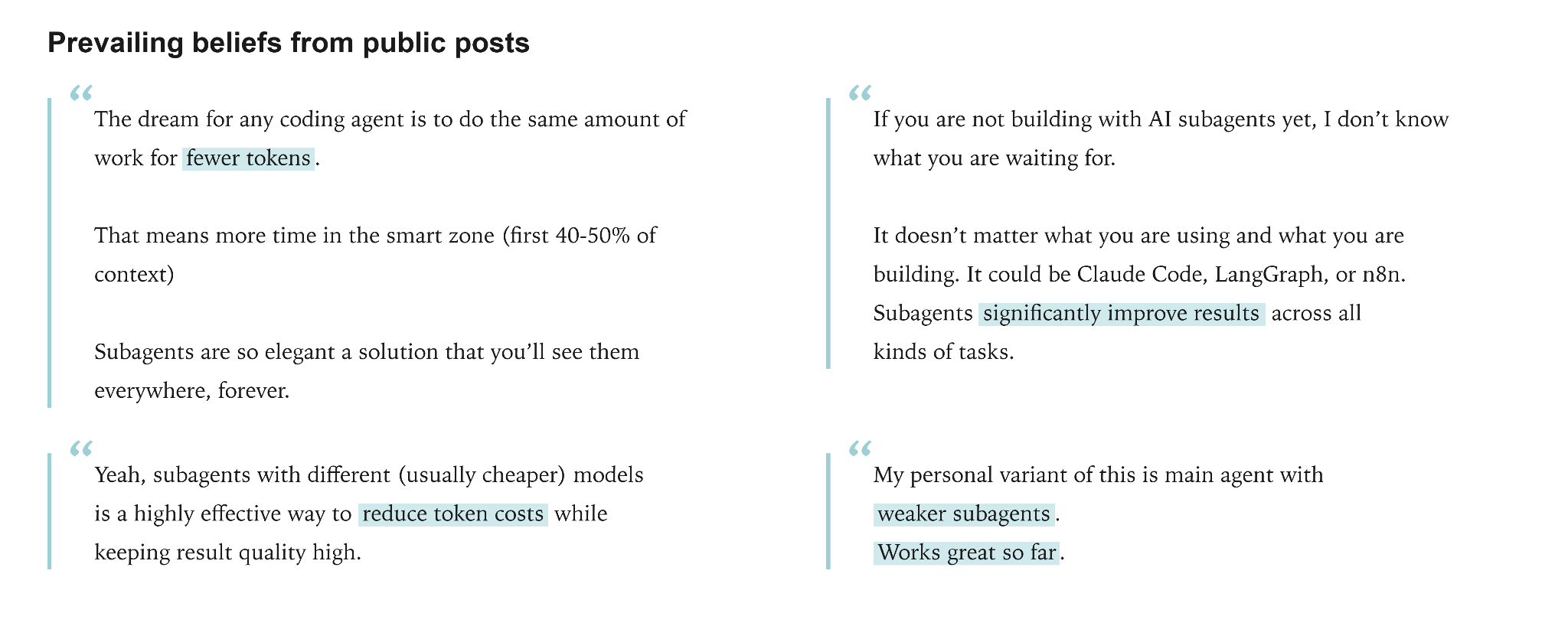
In fact, Claude Code's own documentation lists cost control as one of the core reasons to use subagents, alongside preserving context and enforcing tool constraints: "Control costs by routing tasks to faster, cheaper models like Haiku." An ecosystem has grown around this idea, abound with curated subagent collections and routers to send tasks to small models while reserving frontier reasoning for hard problems.
With all this hype and excitement, an important question remains: do subagents actually save money on software engineering tasks? The short answer is that the savings you think you see and the savings you get can be very different numbers.
How subagents are supposed to save
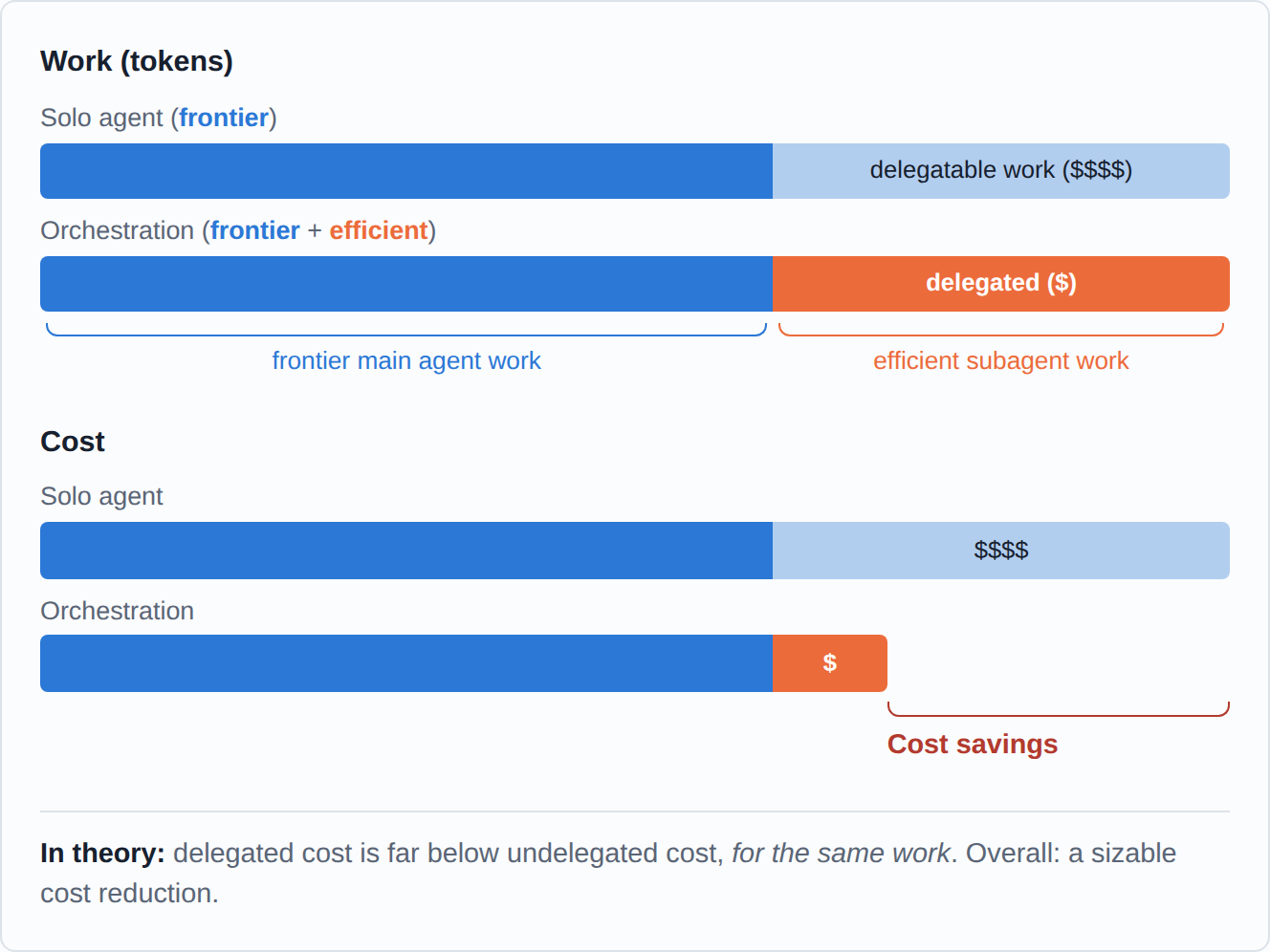
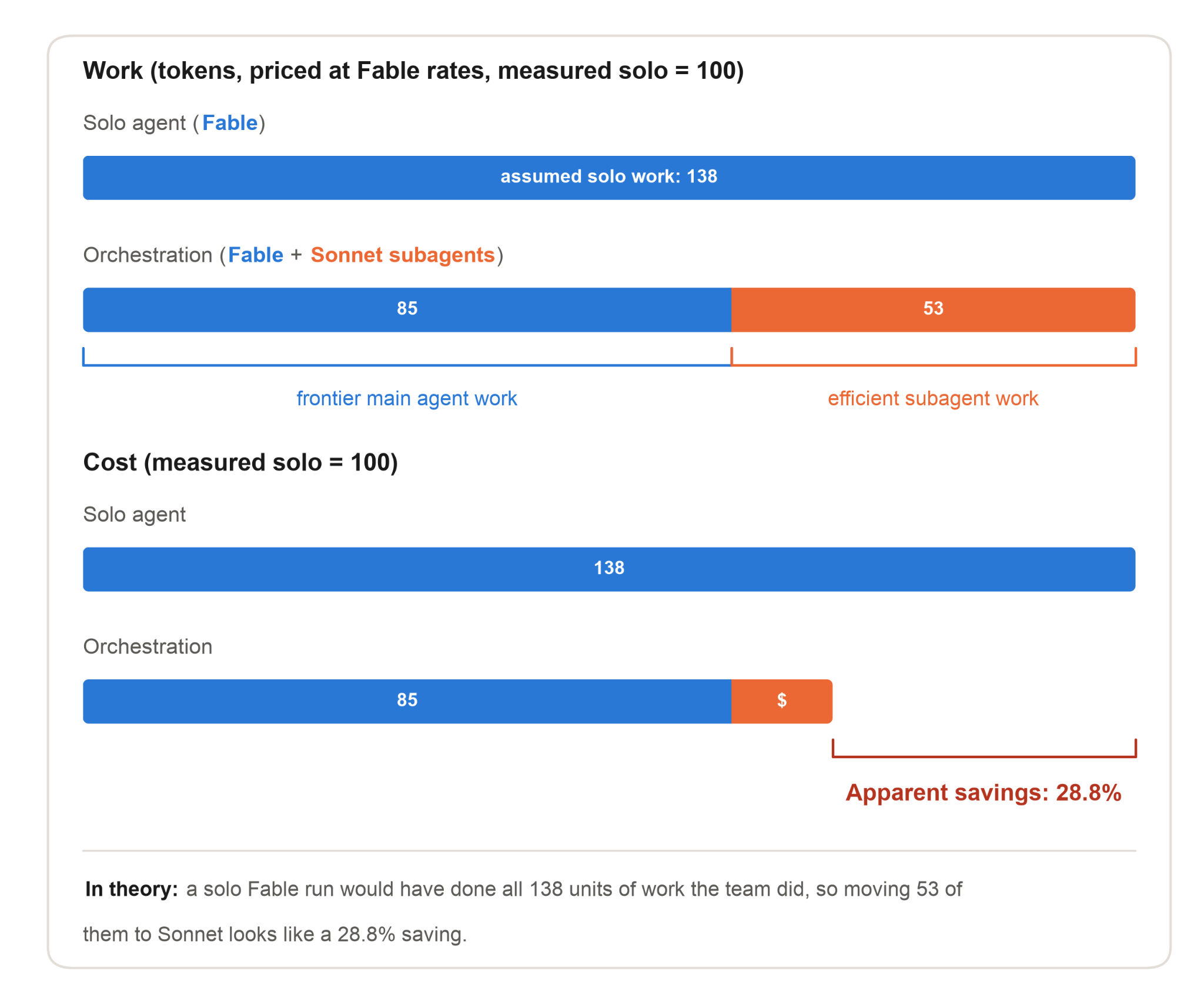
Economically, the logic looks appealing: while a solo frontier agent does everything itself from reading files and searching the codebase to reasoning about the fix and running tests, much of that work doesn't need frontier intelligence. It thus makes sense to give the delegatable part to an efficient, far cheaper model, whereas the rest of the work that needs to stay with the frontier model stays. As shown in Figure 2, since the delegated work costs a fraction of what it would have cost undelegated, in theory, an orchestrated system should be much cheaper.
The apparent savings
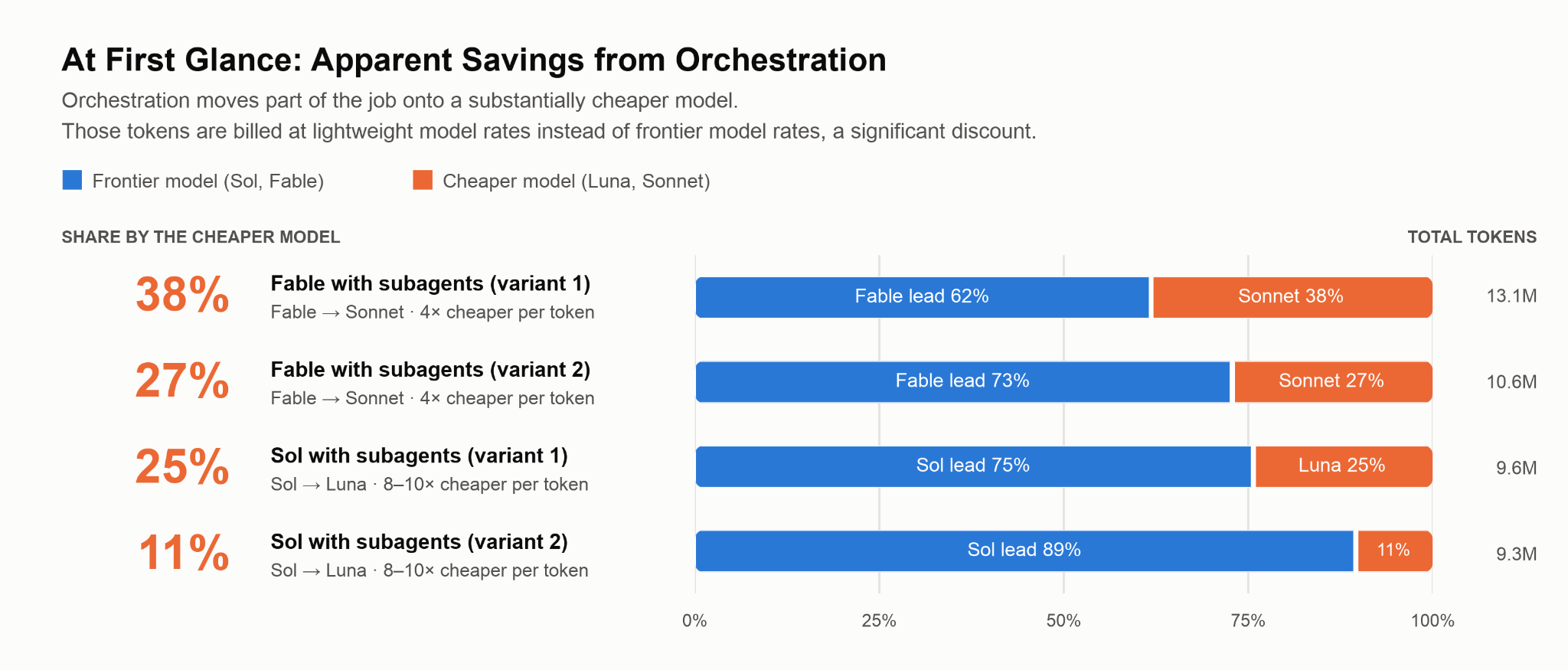
So, how much do we expect to save? To answer this question, we gave frontier models access to cheaper subagents, made sure that subagents were used, and had them solve a few standard agentic benchmark tasks (SWE-PolyBench). Across our Fable and Sol with subagents runs, their corresponding cheaper models consumed up to 38% of total output-equivalent tokens: that’s 38% of tokens on discounts of 75%-90%, since they used the cheaper model’s rates instead of the frontier rates (per token, Sonnet is 4x cheaper than Fable, and Luna is 8-10x cheaper than Sol).
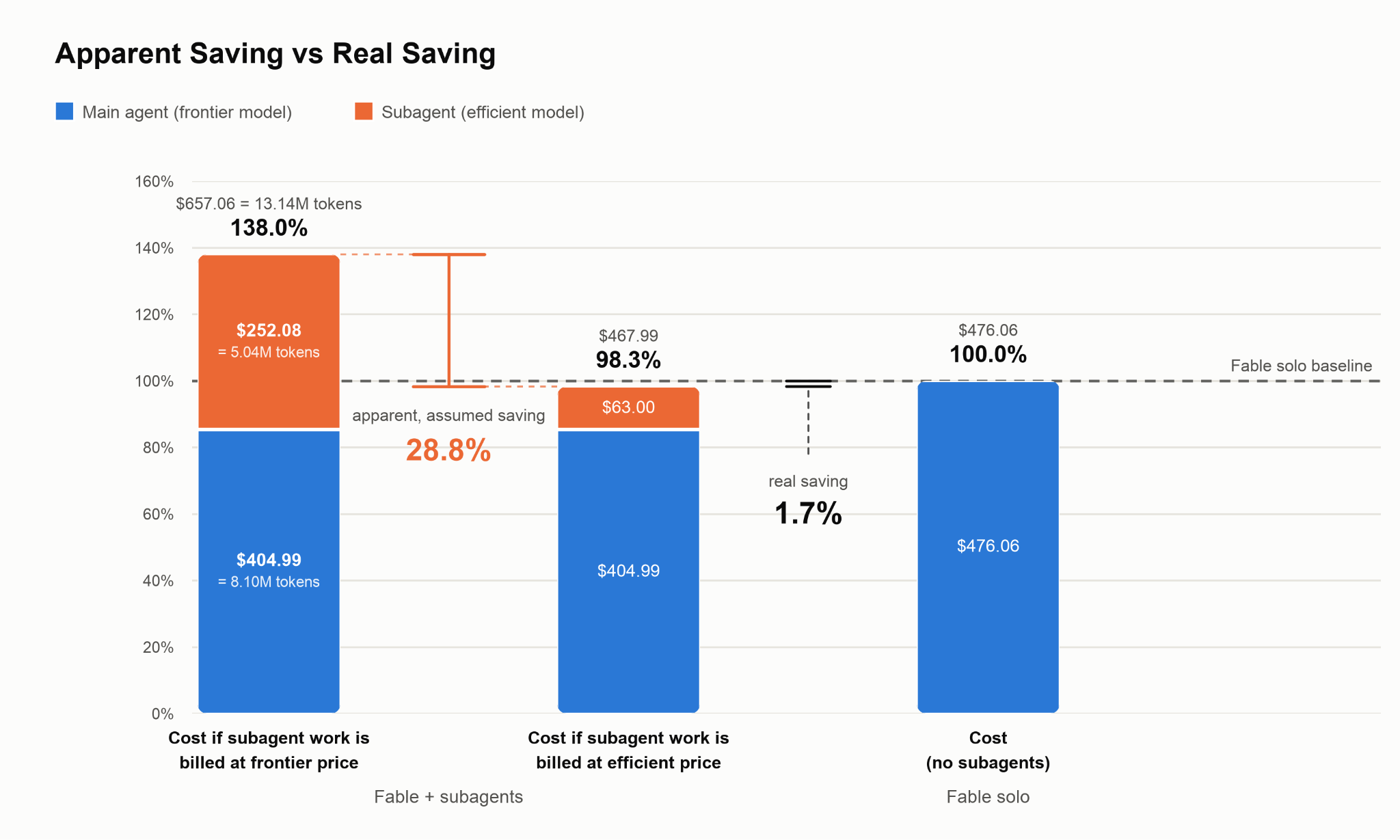
With the Sonnet portion priced at Sonnet's rates, the bill was $468. Fable with Sonnet subagents’ whole run would have cost $657, if the subagents part had been done by Fable and priced at Fable’s rates. Having 38% of tokens delegated to the cheaper model gave us a 28.8% saving!
Many engineers are excited to watch their subagents working hard. With cheap subagents, every file it reads and every test it runs are work that would otherwise have been done at a higher price, so it must be saving money! It's the same feeling as a trip to the department store with a stack of coupons: every coupon is money off, so the purchase must be a bargain.
Except that coupons have a way of sending you home with bags full of things you didn't plan or need to buy.
The soloist doesn’t necessarily do the same amount of work as the team
Computing the 28.8% figure compares the orchestrated run against a hypothetical where the same work is done by Fable, but a real Fable solo run doesn't necessarily do the same work or amount of work.
What happens if we swap out the hypothetical run with a real one? Do we see the savings we expect? Do they save more? Or do they save less?
When Fable did the work solo on the same 200 tasks, it cost… $476. Against $468 from the orchestrated run, the real saving is 1.7%, surprisingly far less than the 28.8% we expect: indeed, the hypothetical solo cost of $657 from which we derived 28.8% savings from was almost 1.4x the actual solo frontier’s cost!
What happened? Why?
The two views below are different ways of calculating “savings”; compare them below. Between them, the orchestrated run is the same, but they compare that run with different solo baselines.
Assumed solo run
Measured solo run
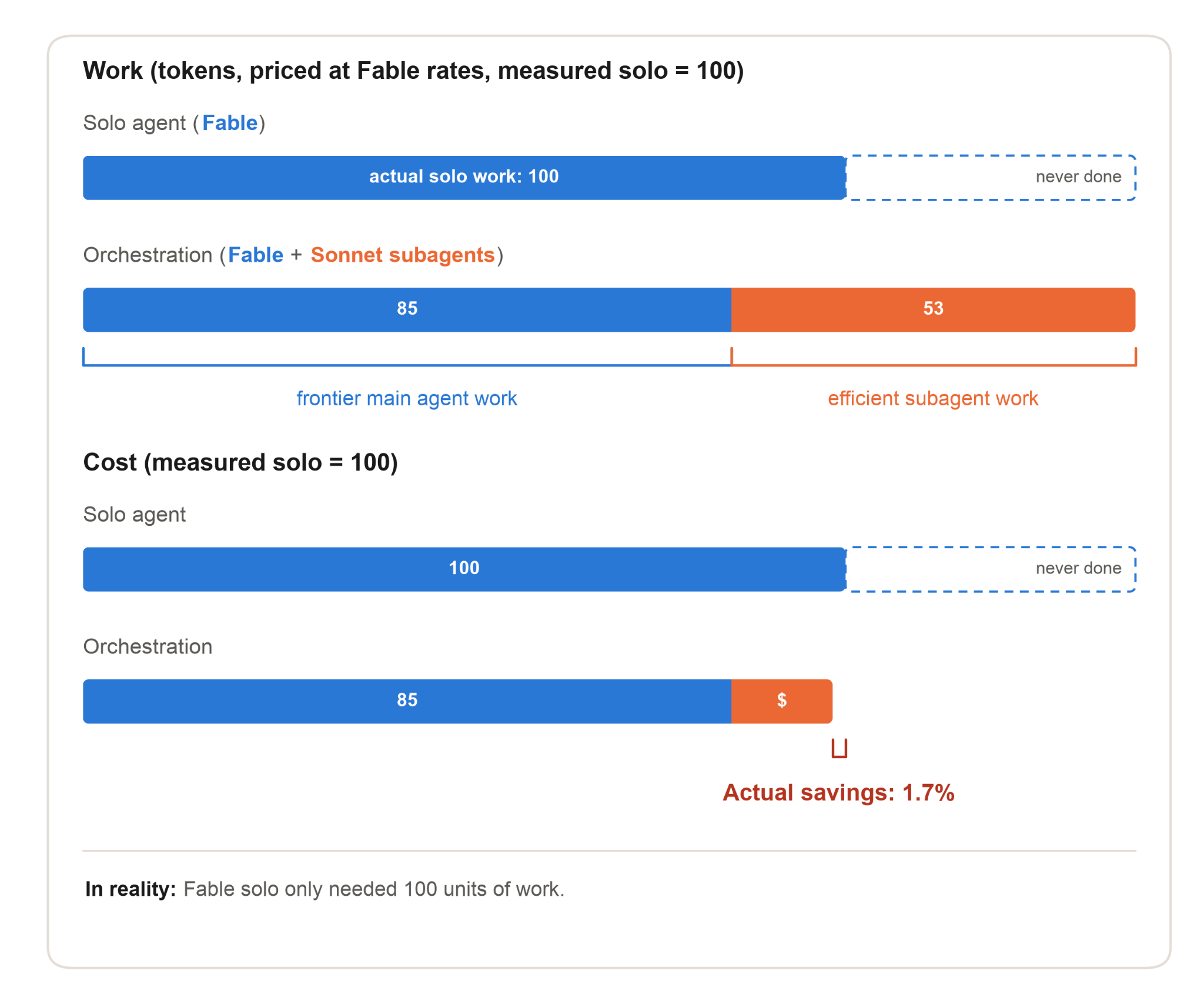
With the two views side by side above, the problem is evident: comparing only the left and middle columns in Figure 4 only measures the discount on the delegated tokens and doesn’t actually say whether delegating was worth it. In particular, this measure of “savings” never indicates a loss: apparent savings will only ever say that you “saved.”
The right test puts the treatment against a real control: the right column. Like an A/B test, the comparison should thus be between the middle column, the orchestrated run billed at the subagents' actual efficient price versus the right column, the same tasks run solo with no subagents at all.
Where did 27% of savings go? Each unit of frontier work offloaded was replaced by roughly 3.5 units of subagent work, so subagents did more work than they saved solo; with Sonnet about 4 times cheaper, 3.5 times the work at a quarter of the price nets out to marginal gains. It also wasn’t just the subagents that did more work: the main agent also had to brief subagents, read their reports, re-explore what the lead didn't trust, coordinate hand-offs, and more. When orchestrated, the total workload amounted to 138% of what the soloist needed.
Delegation saves money only when work inflation is justified.
Work inflation is how much more work the subagent does than the lead would have done solo for the same subtask.
Thinking back to the coupons, the 28.8% is the "You saved!" line at the bottom of a department store receipt: the full price of everything you bought, minus what you paid. Though it’s a real number, it’s not your actual savings because you bought more than you would have without the coupons. The right test to know what you saved is to compare the receipt with a trip made without the coupons, and our coupon-free trip, Fable solo, came to within 2% of the coupon trip.
That coupon-laden spree might have felt good, but you haven’t won much if your goal was to beat a normal trip.
Even on the task level, apparent savings don't predict real savings
Below is a scatterplot of the results of solo vs subagent strategies where each point is a task.
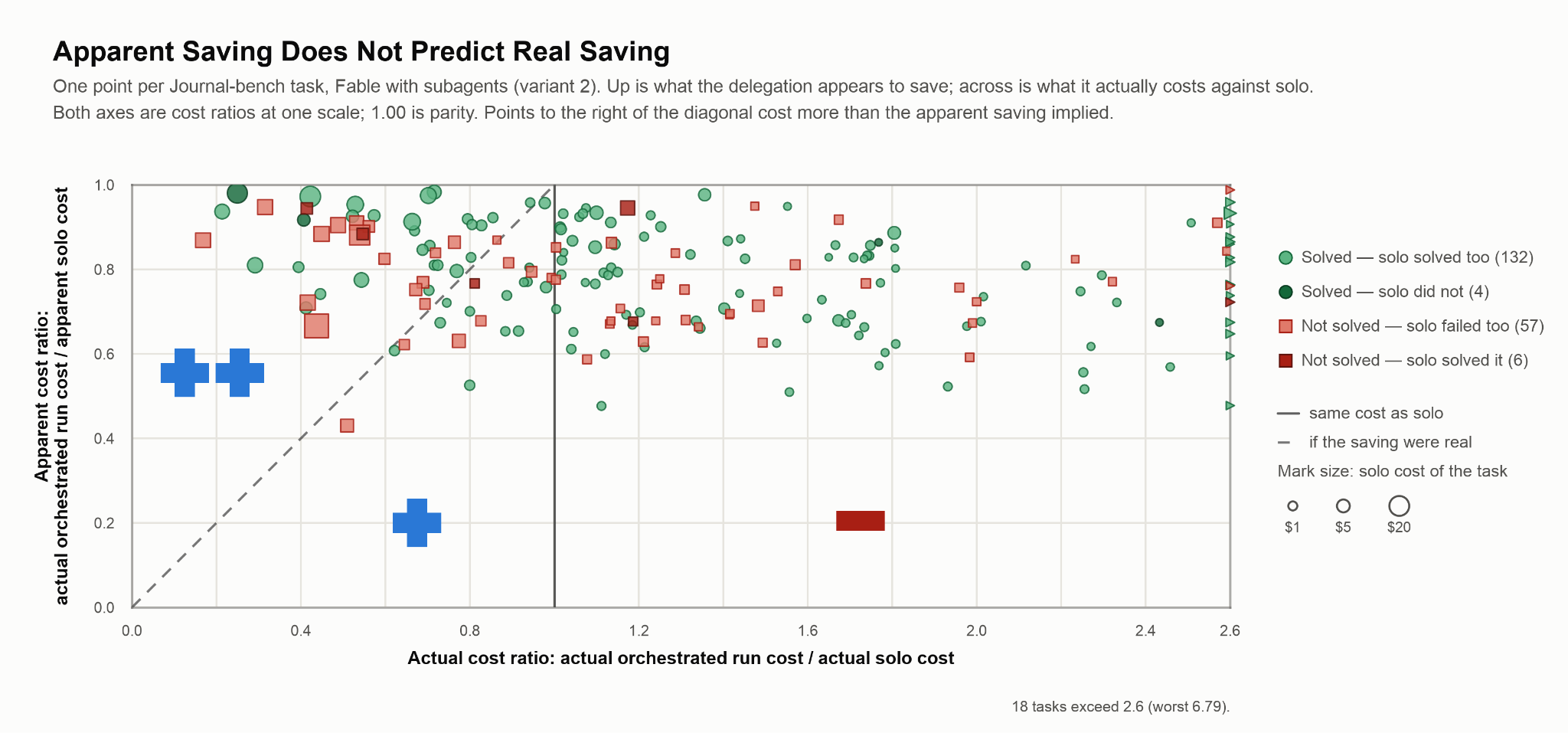
In Figure 6, the solid line x=1.0 represents Solo as the baseline. A point to the left indicates the subagent strategy costing less than the solo strategy, while being on the right indicates higher cost. The dashed line represents the comparison between apparent savings and actual savings. If the apparent saving matches the actual saving for a particular task, its point would lie around the dashed line. Above the dashed line, we save more than we expect from apparent savings, and below/to the right, otherwise.
We can divide the area into 3 regions:
- Above the dashed line (++): our subagents strategy saves and saves even more than apparent savings suggest.
- Between the dashed and solid lines (+): the actual savings are less than what apparent savings say, but we still save.
- To the right of the solid line (-): subagents are more expensive than solo, not even saving at all anymore.
Evidently, as shown in the plot, apparent savings do not predict actual savings. Overall, the tasks (points) look pretty scattered around the solid solo-baseline line. Weighing the points appropriately by their costs, as represented by the bubble size, the subagents strategy tallies up to be 1.7% cheaper than solo, far from the 28.8% espoused by apparent savings calculations.
Where does the extra work come from?
At least for the current models as of now, subagent savings aren’t as rosy as we might hope, but why? Let’s unpack 3 cons of subagents that we have found to drag the pros.
Unruly agents don't obediently stay in the roles you give them: leads delegate things they were told not to, and subagents stop halfway or redefine their job. Imbalanced team dynamics such as groupthink, adversarial overcorrection, and a poor balance between self-confidence and self-doubt make teams second-guess, re-verify, and obsessively overthink. Last but not least, coordination overhead manifests in tokens being charged on both ends of the hand-offs.
That said, this doesn’t mean subagents never save money. In our tests, certain setups delivered statistically significant savings. For instance, Sol with Luna subagents cut costs by 21%, while a different Fable-Sonnet setup saved 12%. The difference came down to prompt formulation, model combination, and the nature of the tasks.
Still, cost only accounts for part of the optimization. A strategy that saves money but solves much fewer tasks offers little practical value. To get the full picture, we need to evaluate both cost and accuracy together, across strategies, models, and benchmarks.
Continued in Part 2, the full study of cost vs accuracy...