Do Subagents Actually Save Money? [Part 2]
Orchestration is not universally helpful: it can cut frontier agents’ costs by 12-21%, but without the right instructions, it can make a frontier agent costlier, slower, and obsessive.
By Jonathan Sakunkoo and Anand Avati
Does giving a coding agent subagents make it cheaper, more accurate, or both? The answer isn’t so obvious, given that there are many good arguments pointing in different directions. The first line of thought promotes subagents as a way to spend less: subagents help “control costs by routing tasks to faster, cheaper models”. The second views coding, which is mostly sequential, as a poor fit for subagents. Others espouse a single agent system as they say that even agents working in parallel may be a liability as they make conflicting decisions.
We conducted over 5,000 agent runs across a dozen orchestration strategies and 3 coding benchmarks to find out.
Orchestration: What and Why?
As a starting point, let’s begin by imagining a default solo software engineering agent: one model doing everything itself. This is the simplest form of agentic software engineering.
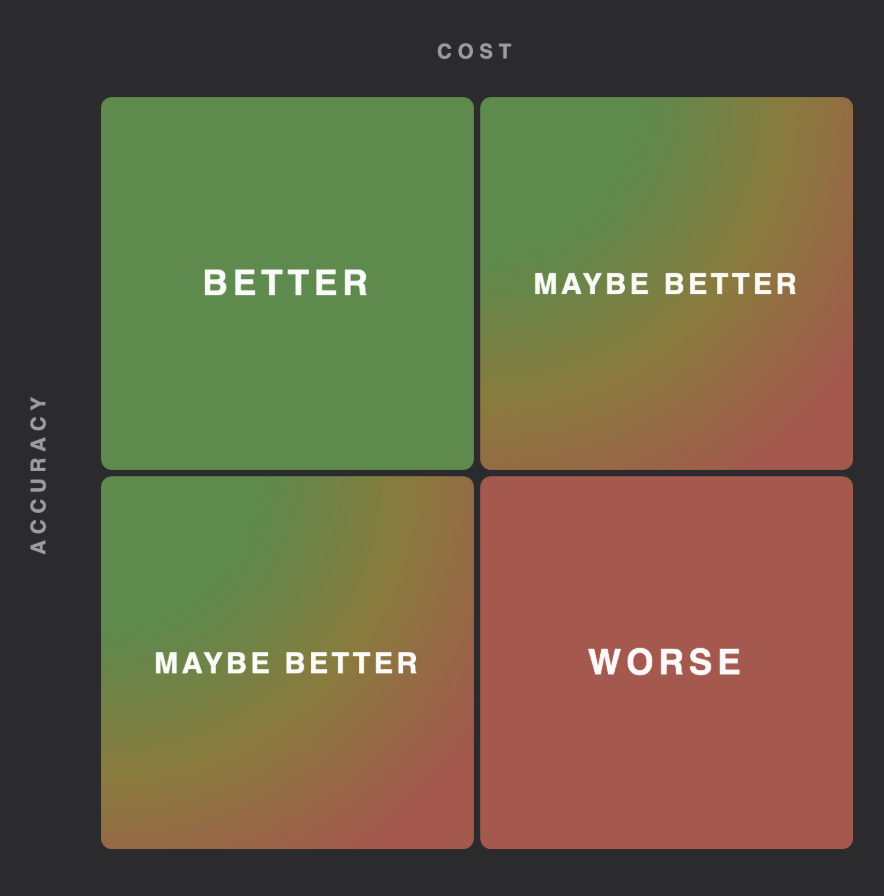
With a solo agent’s performance as a baseline, we ask ourselves: what does it mean to do “better”? Two primary metrics come to mind: accuracy and cost. The figure above has the single-model baseline at the center origin to highlight the trade-offs required to beat it.
The top-left quadrant is the primary goal, indicating a total win: higher accuracy at a lower overall cost. If that isn’t feasible, an effective multi-agent setup would be in one of 2 productive quadrants: either pushing upward to gain superior accuracy (even at a higher cost) or shifting left to reduce costs (without sacrificing too much accuracy). A strategy residing within these quadrants might or might not be more “efficient” than a solo agent, depending on the relative importance of cost and accuracy. Any orchestration strategy that simultaneously increases costs and reduces accuracy falls into the bottom-right worse quadrant, which leaves the solo agent as the clearly “better” choice.
Having established how we can measure doing better, how can we do better? How do we push past the solo agent’s baseline at the origin and move into higher-value target quadrants? One idea is built on the microeconomic principles of division of labor and comparative advantage. Much like a team where work can be subdivided between its members, orchestration refers to an arrangement where a main agent coordinates work between itself and other agents specifically assigned to perform some tasks and report back to the main agent. These other agents are called subagents, and orchestration commonly involves the main agent spawning subagents, delegating work to them, and acting on what they return. Rather than forcing a single model to execute every subtask, an orchestrated framework enables specialized subagents with distinct roles tailored to their relative cost-efficiency to take on tasks best suited for them. For example, lightweight models may execute high-volume data retrieval and routine processing, while high-reasoning, expensive models are reserved for critical judgment, strategic planning, and final validation. They can scout, plan, implement, test, or review. Subagents can be cheaper or stronger than the main agent. By combining models, a multi-agent team may achieve operational flexibility, speed, and resource optimization.
What we ran
After evaluating a wide range of models and strategies and eliminating clear underperformers, our final experiments narrowed focus to configurations built around two primary models: Sol, a frontier model, and Luna, a much cheaper, lightweight model from the same provider, OpenAI. Later we added Fable, a stronger frontier model from Anthropic, and GLM-flash, a very low-cost, high-capability model, to see whether what worked for Sol transferred to Fable and what did work for Fable.
In the setting of a main agent with access to subagents, we can consider using strong and weak agents together. Two ideas come to mind: have a frontier model as a main agent which can delegate work to weaker, cheaper agents, or have a lightweight main agent which can delegate certain hard parts to a more expensive, wiser model. We tried both ways of pairing them.
Start strong, offload the rest: Sol as the lead, main agent with a Luna scout and implementer, told to delegate only when a call would cost less than doing the work itself.
Start cheap, add judgment: Luna as the lead with Sol as a reviewer at the end or Sol as a planner early on.
In addition, we introduced a hybrid third strategy class - in a way frontier-based, but distinct nonetheless:
Mid-Switch: Sol runs solo, and if the agent seems to be struggling, a custom scout is dispatched. The scout returns helpful information it finds from the task’s repository relevant to what the agent has been struggling with, which is then given into the main agent.
We evaluated across 3 distinct benchmarks: a 200-task subset of SWE-PolyBench (finding needle-in-a-haystack fixes in large, unfamiliar codebases), Terminal-Bench (practical, diverse shell-based computer work), and DeepSWE (long-horizon tasks judged strictly on end-state verification). The underlying execution harness remained constant across the runs.
One central question: Is there a single orchestration strategy that achieves superior cost-accuracy performance across the board?
Below are what we found.
1. Subagents could save money but did not consistently boost accuracy
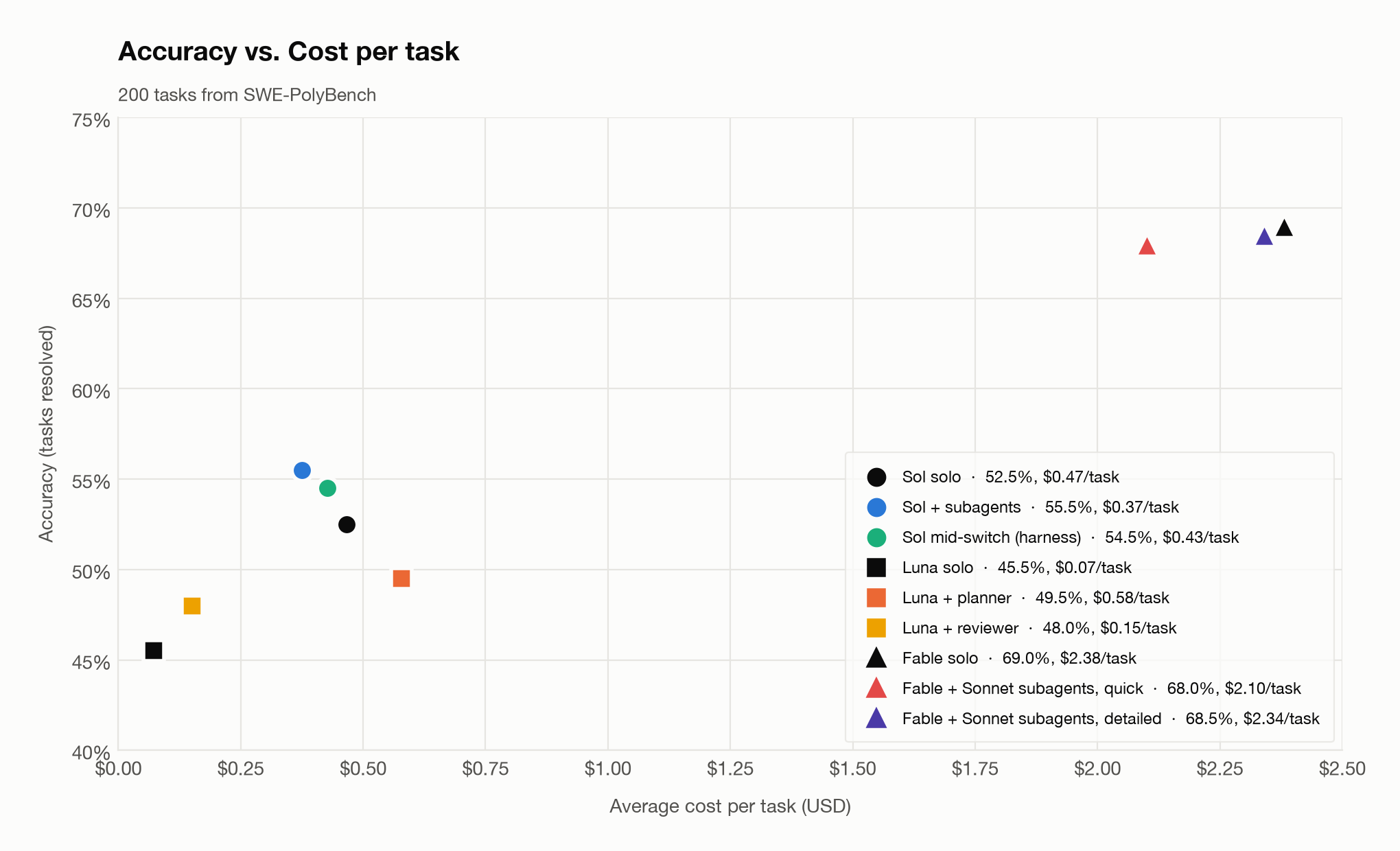
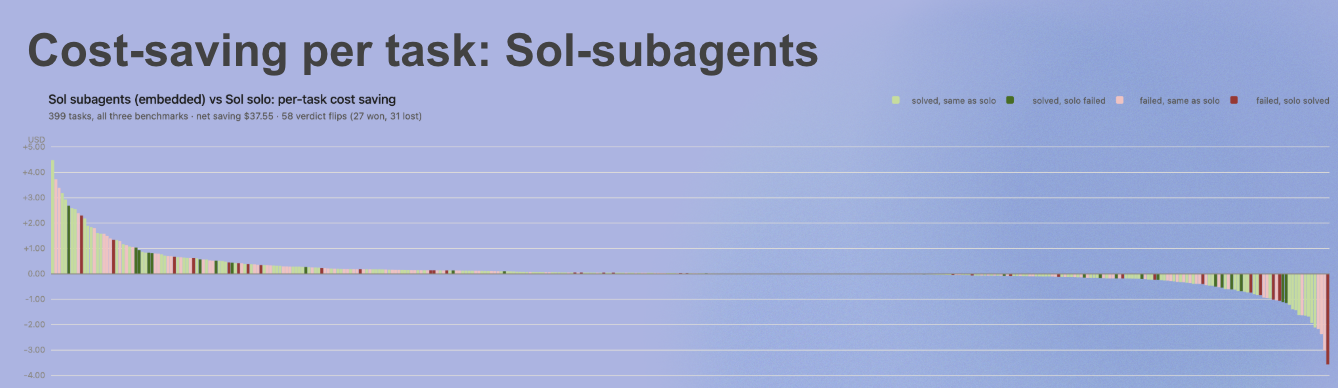
Compared with 52.5% accuracy at $0.47 per task for Sol solo, our Sol with Luna subagents strategy resolved 55.5% of tasks at an average cost of $0.37, a 21% cost reduction (statistically significant in a paired comparison across tasks: p < 0.001), on the SWE-PolyBench subset. The accuracy gain is 3 points, and 88% of tasks were uncontested between the 2 strategies. On DeepSWE, the same strategy was slightly cheaper with no significant difference in accuracy, while on Terminal-Bench, we saw the cost saving at an accuracy drop of 6 points.
Across the board, this subagent strategy cuts costs. Where did the savings come from?
Our strategy provided 2 subagent roles: scouts and implementers. The SWE-PolyBench tasks are rather discovery-heavy, which explains the savings from a scout: as much of a solo run’s spend is finding out what is going on, with a scout available, Sol’s own reasoning per task fell from 9,750 tokens to 7,810. The expensive model stopped paying to read the codebase and judiciously offloaded the easy part.
When the tasks are stratified by repository size, subagents pay off above roughly 20,000 lines of code. The benefit of Sol with subagents was also more pronounced on JavaScript and Python tasks.
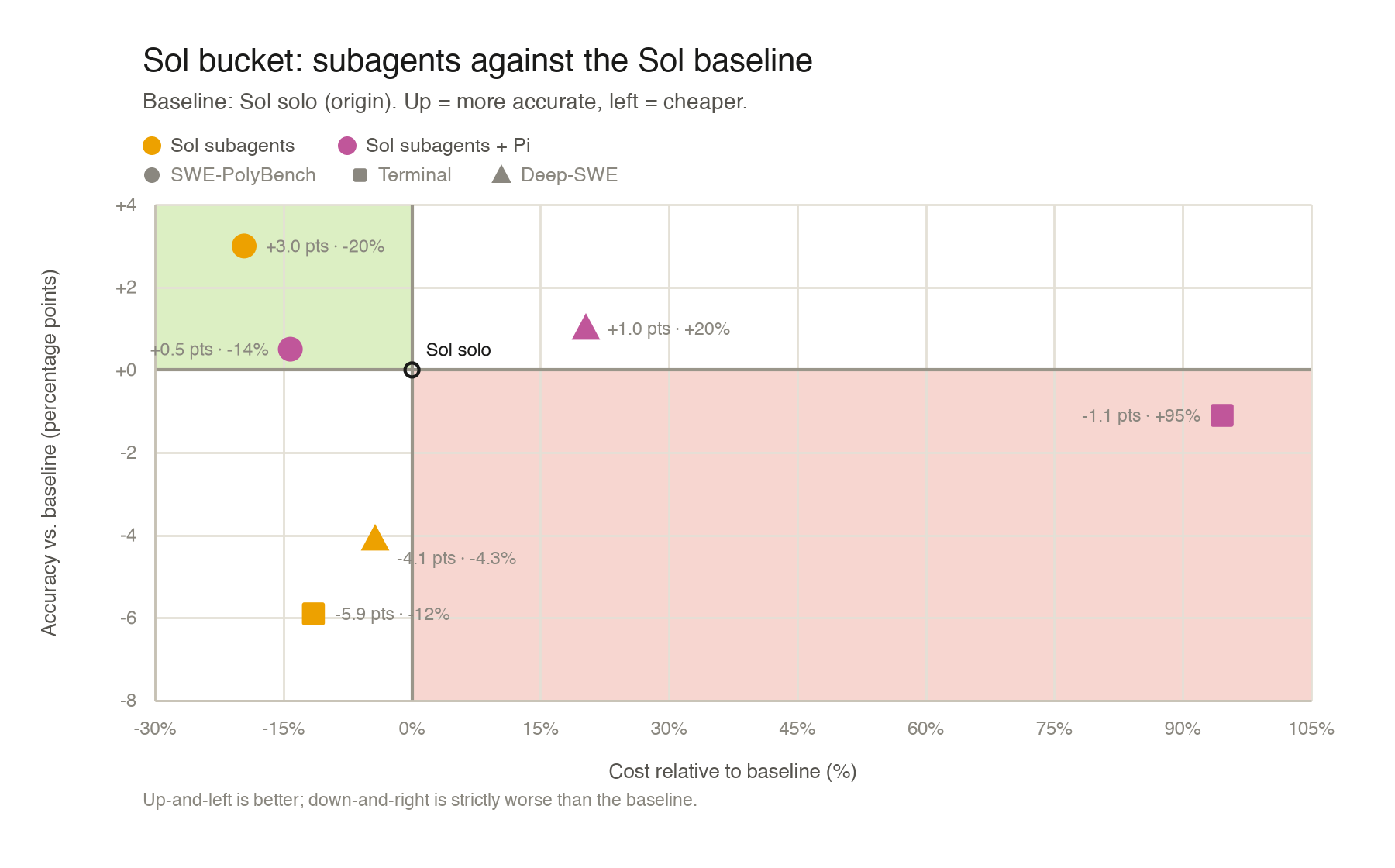
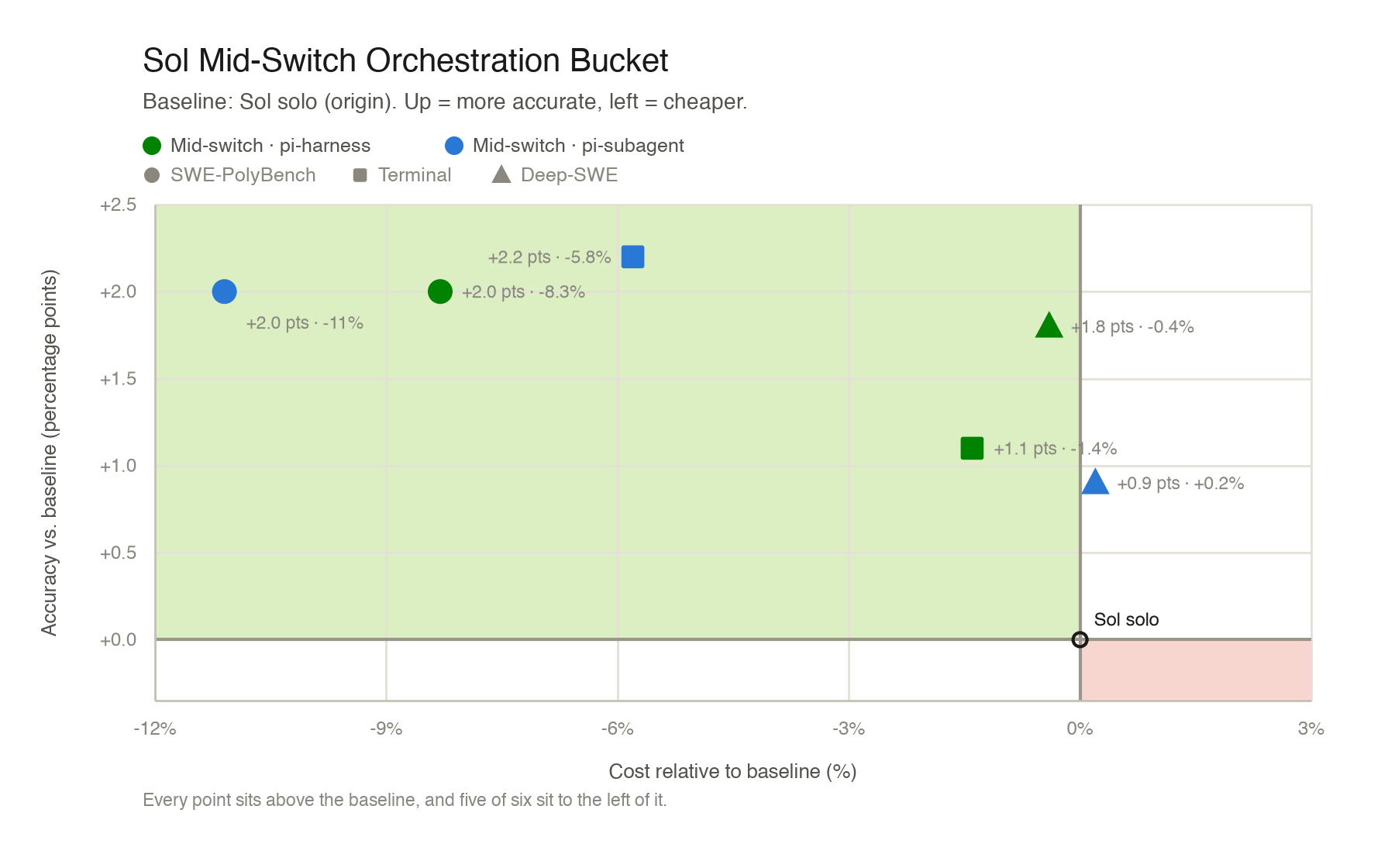
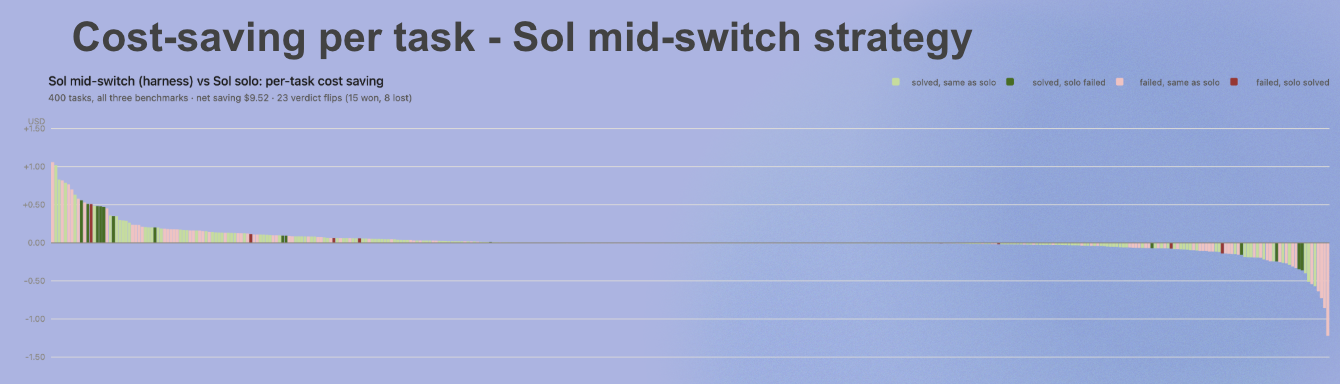
We also developed a mid-switch subagent strategy where the solo agent is first assigned to do the task on its own, and a subagent is introduced only when the signs of struggle are detected1. (We tried two variants: in one, the detection and subagent spawning is handled by the harness, while in another, these were the responsibilities of the agent itself. Accuracy and cost differences were negligible.)
It was the best strategy on Terminal-Bench, but it did not perform well on DeepSWE. The reason points to something more general about when adaptive orchestration works: on Terminal-bench, agents tend to fail early and visibly, thus giving the harness a useful signal for when to inject a sub-agent to help. On the contrary, it is much harder to tell early whether a run is headed toward success or failure on a DeepSWE task, since failure often becomes apparent only near the end here. Adaptive orchestration needs something meaningful to adapt to, and so it works best when tasks show reliable warning signs early enough for a strategy switch before it’s too late.
2. A lightweight leader cannot hire its way up
What if we reverse the strategy by putting a cheap model in charge and buying frontier intelligence only when needed?
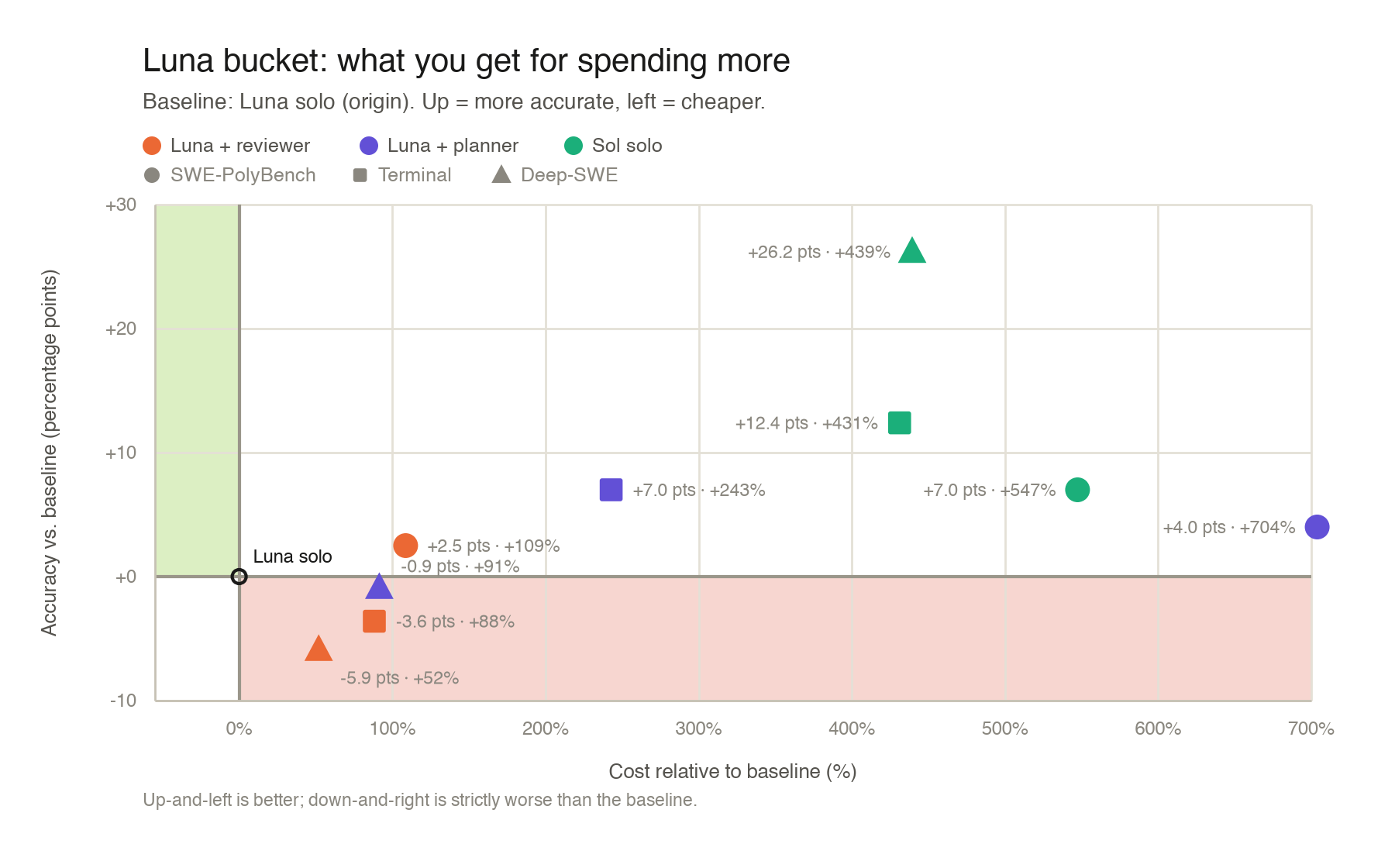
We can give the Luna main agent a frontier Sol reviewer to check its work at the end or give the Luna main agent a frontier Sol planner to detail the solution and implementation at the start.
It sounds economically attractive: cheap by default, intelligence where necessary. However, in our experiments, giving a Sol reviewer to Luna hurt accuracy on 2 of the 3 benchmarks and improved accuracy by just 2 points on the third, while roughly doubling Luna’s cost. It turned out that Luna was not good at acting on critiques it had not generated itself, while Sol, reviewing work it had not done, tended either to rubber-stamp the result or request changes Luna could not successfully make.
What if Luna has Sol available as a planner? We found that a plan is only valuable if the worker can keep following it. On long, repository-scale tasks, Luna often read the plan and then proceeded to do essentially the same work it would have done without one.
In fact, Luna loves to delegate the whole task to Sol, rather than sticking to instructions. Early on, when told to use Sol only for review, Luna quietly delegated the whole task to Sol on 49 of 67 tasks. The accuracy rate thus matched Sol solo’s accuracy, but unfortunately at 177% of Sol solo’s cost.
We had discovered perhaps the least efficient way to get Sol’s answer: hire Luna as a manager.
As a fix, we tightened the rules regarding Sol’s role. Accordingly, cost came down, but accuracy did too.
Overall, for Luna, the pattern is hard to escape. The frontier judgment is difficult to bolt onto a weaker main agent productively. If frontier-level performance is the goal, putting the frontier model in charge works better than asking a cheaper model to borrow its judgment through frontier planning or review.
3. Misbehavior and Team Dynamics
Every strategy tried to cheat in our experiments. Each one, at some point, attempted to look up the answer online: they tried to fetch an upstream fix commit and reasoned about whether network restrictions would let it: “Network is available. Let me fetch the upstream fix commit.” In one unique self-aware instance, Luna as the main agent talked itself out of it: “I should avoid using bash for external calls.”
Interestingly, cheating was not the only misbehavior observed.
Unruly agents do not keep to their roles
Agents did not always stay in the roles we gave them, particularly when the wording left even a little room for interpretation. Without strong roles and prompts, delegation does not happen in intended, controlled, meaningfully comparable manners.
Luna handing off the whole work to Sol instead of merely having Sol review it was one example. In another situation, the task was to implement missing functionality. The agent inspected the codebase, correctly identified what was missing, but then documented that the feature was missing and then stopped, as though simply confirming the problem’s existence had completed its job!
One lesson is that agent roles are not binding contracts. The roles may sound unambiguous to us, but agents can interpret the boundaries very differently. Small changes in directive wording sometimes change not just how an agent performs its role, but what role it believes it has.
Groupthink, adversarial behavior, and the confidence balance
Introducing coordination between agents also presented some unwanted behavior patterns.
One such behavior is groupthink that may hurt performance and cost. On one Material-UI task, the implementer made a mistake. The Luna tester incorrectly decided that the code looked sound: “The runtime and TypeScript implementation look sound, with no apparent semantic defect in the primary/secondary handling.” Sol, the lead agent, noticed the problem, reasoning that the implementation “makes sense at a glance but might actually be incorrect” and then describing the correct fix. However, the main agent decided to submit the implementer’s incorrect code unchanged, as the tester had approved it.
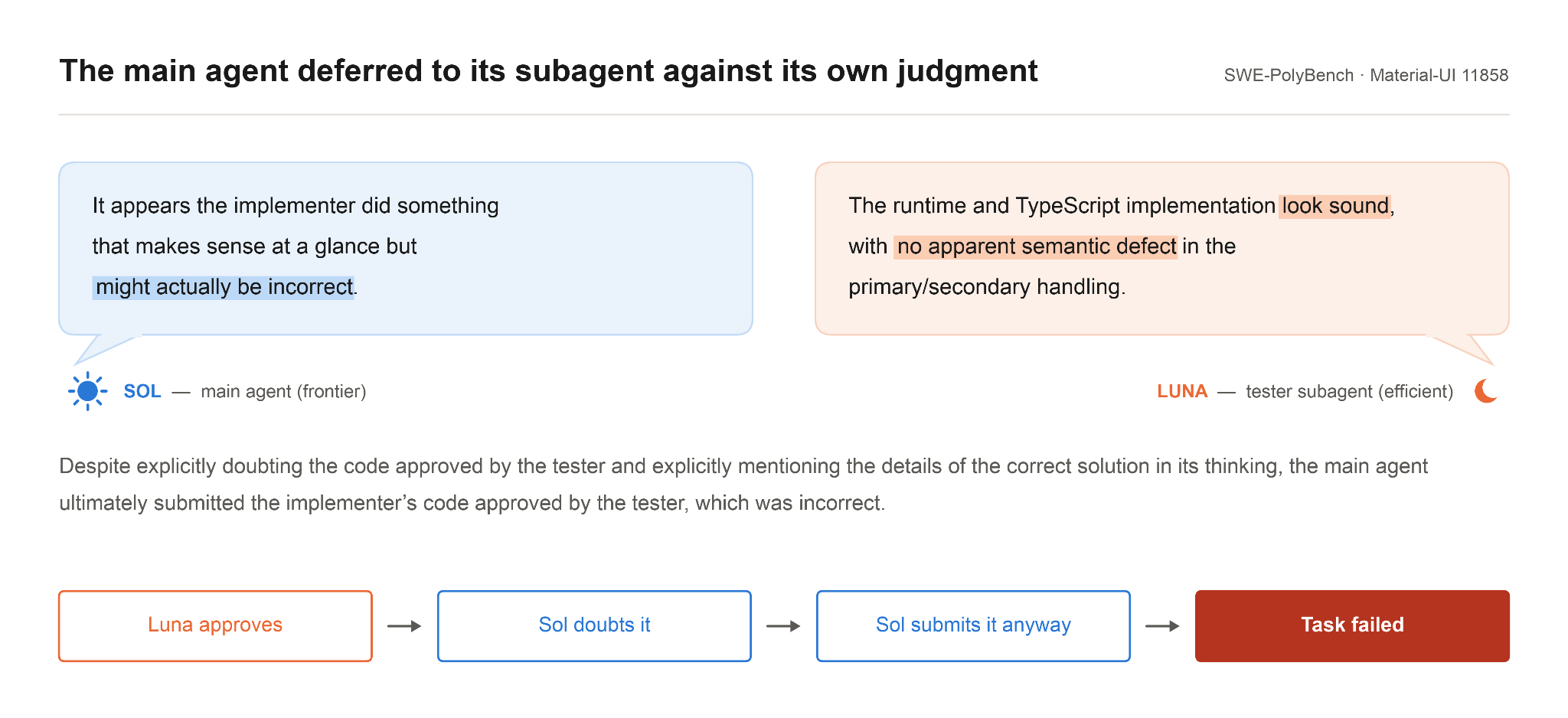
A competent model, on its own, likely has been tuned to balance self-doubt and self-confidence. It questions itself enough to catch mistakes, but not so much that it abandons correct reasoning. However, when put inside a team, it can lose its delicate balance between self-doubt vs. self-confidence.
As described above, when lead and subagents are too agreeable, the team drifts toward groupthink. Yet, pushing agents too far in the other direction creates the opposite failure mode. When told to avoid overt complicity and to reason independently, agents become too adversarial and begin finding faults that are not there. This also induces overthinking in a form of adversarial overcorrection.
So the orchestration problem is not simply solved by making agents disagree more: an effective setup needs to preserve the right balance between confidence, trust, and doubt across a team.
A good agent is not necessarily a good sub-agent
Another lesson is that solo performance tells you very little about sub-agent performance.
In one experiment, we replaced Sol’s Luna scout with GLM-flash. On the same tasks, GLM-flash as a solo agent was the stronger model by a decent margin: it could solve 36 of 67 tasks versus Luna’s 29, and GLM was 2.7x cheaper per token. At first glance, GLM looked like an obvious upgrade for the subagents team.
Surprisingly, the team got worse. While Sol with a Luna scout solved 39 of 67, Sol with a GLM-flash scout solved 37. On 5 tasks, Sol’s subagent team succeeded with Luna as the subagents but failed with GLM-flash as the subagents, yet GLM-flash, when running solo, had solved 3 of those 5 itself.
This means that, although GLM knew how to solve the task, its scout report did not lead Sol to solve it. Sol’s own effort was essentially identical in both conditions, so what changed was the information coming back from the scout.
Furthermore, that information arrived much more slowly. GLM-flash, while much cheaper per token, used 4.4x as many reasoning tokens per dispatch. The average task time rose from 513 seconds with Luna to 688 seconds with GLM-flash. The slowest task stretched from 1,490 seconds for Luna to 4,992 for GLM. A subagent that is cheaper per token but takes many times as long to return can change whether delegation is worthwhile at all; despite its low token price, GLM may not be the cheaper sub-agent.
A broader lesson is that a sub-agent’s solo score does not tell you how good a sub-agent it is. Being a good sub-agent requires a different skill set from just being a strong solo agent.
Fable runs
What about Anthropic’s Fable, one of the leading frontier models available today? Fable alone solved 138 tasks out of 200 (69%) from SWE-PolyBench in our runs. Does and how could orchestration help Fable? Let’s find out.
Our experiment consisted of 3 strategy variants with Fable as the main model.
- Detailed prompt. Specific guidance on when to use subagents: delegate when it is economic to do so. This results in much economic deliberation. This was the prompt that worked well on Sol.
- Minimal prompt (Only bare minimum subagent usage guidance provided): While we specify roles and descriptions for delegating to Sonnet as subagents, not much guideline was provided in how and when subagents would be used.
- Quick prompt. A middleground: less stringent than the detailed prompt, but some guidance for the agent on effective and efficient subagent usage. In particular, our instructions here tell the main agent to decide subagent usage quickly rather than thoroughly.
Which of these worked the best?
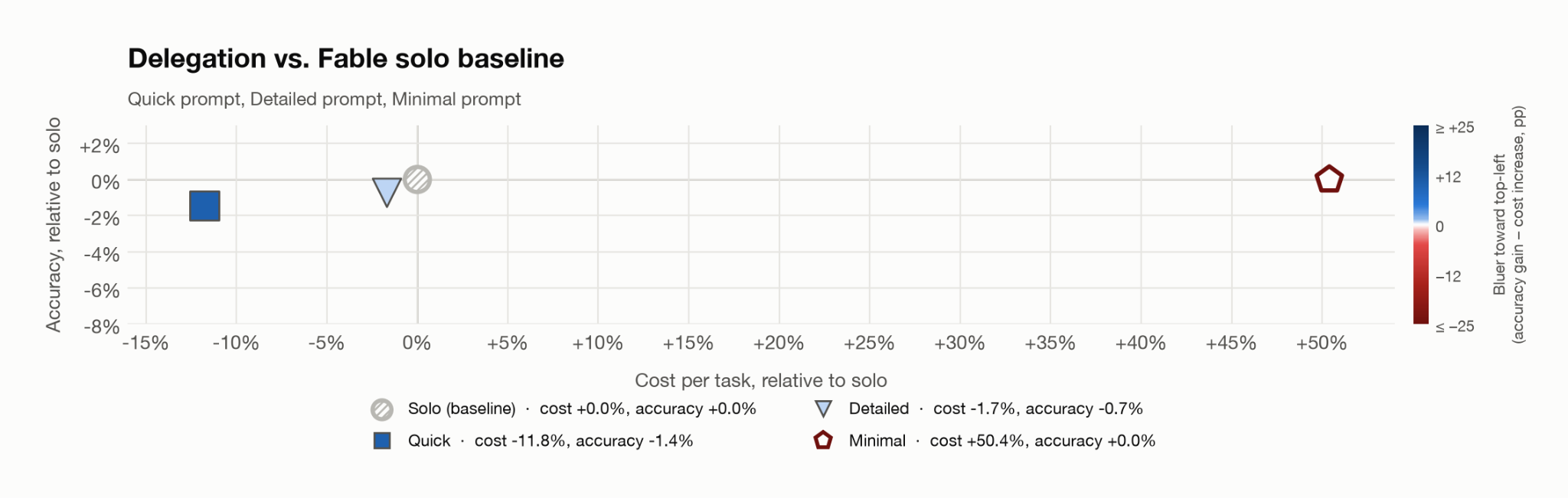
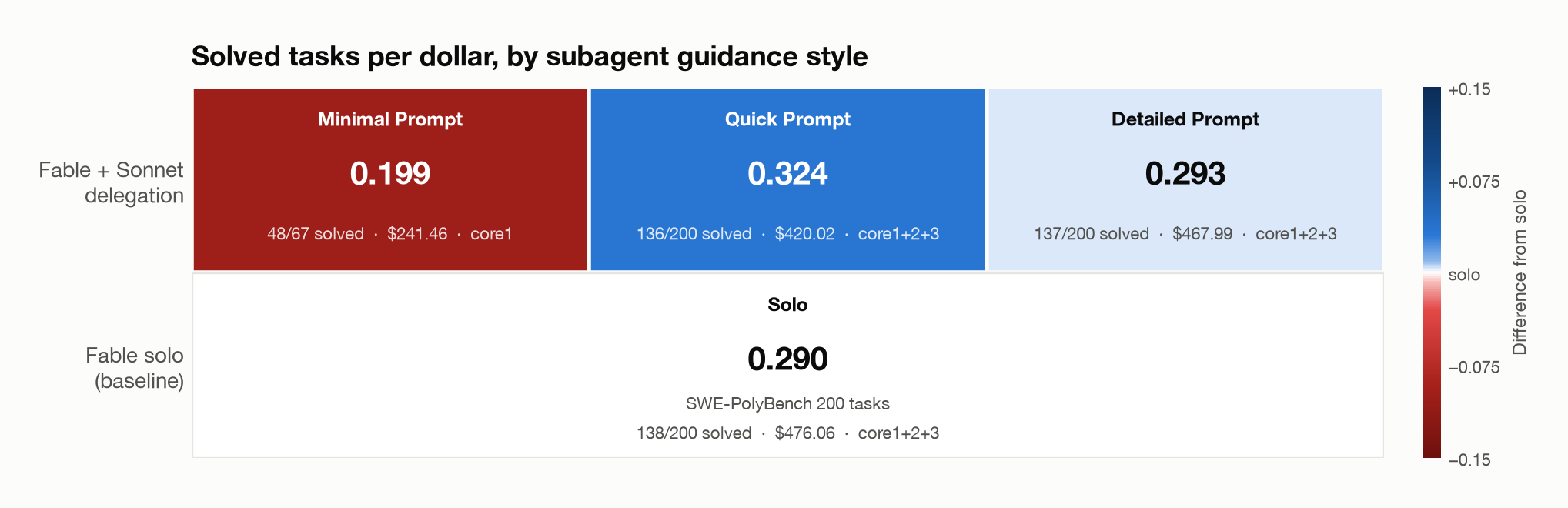
- We found that the quick strategy worked the best out of the 3 policies with Fable: cost was cut by 12%, at only a slight decrease in accuracy (1.4% - 2 fewer tasks solved).
- The detailed strategy reduced cost by 1.7% at a 0.7% decrease in accuracy (1 task fewer).
- The minimal prompt strategy, however, not only cost over 50% more, but it also didn’t improve accuracy compared to the solo baseline.
What can we take away from the results?
First, Fable is very prompt-sensitive. Seemingly inconsequential adjustments in wording can result in very different behaviors and results.
With the same system prompt instruction that allowed the main agent to make a choice whether to delegate or not, Luna delegated things it was told not to, Sol delegated readily, and Fable did not like delegation.
If we want Fable to actually delegate, strong directive wording is needed.
What works for Fable? The middle path: not too much, not too little.
In other words, moderately specified guidance that tells Fable to “quickly” analyze and form a “succinct” high-level plan not too thorough and not too sparse gave the best results in our runs.
Let’s take a closer look at the merits of the “quick” orchestration strategy.
In the plot that follows, color intensity is the cost of the task, as solved by Fable solo, where darker is more expensive. The left side (positive) of the waterfall illustrates the quick strategy’s cost gains over solo, while the right side (negative) shows the losses.
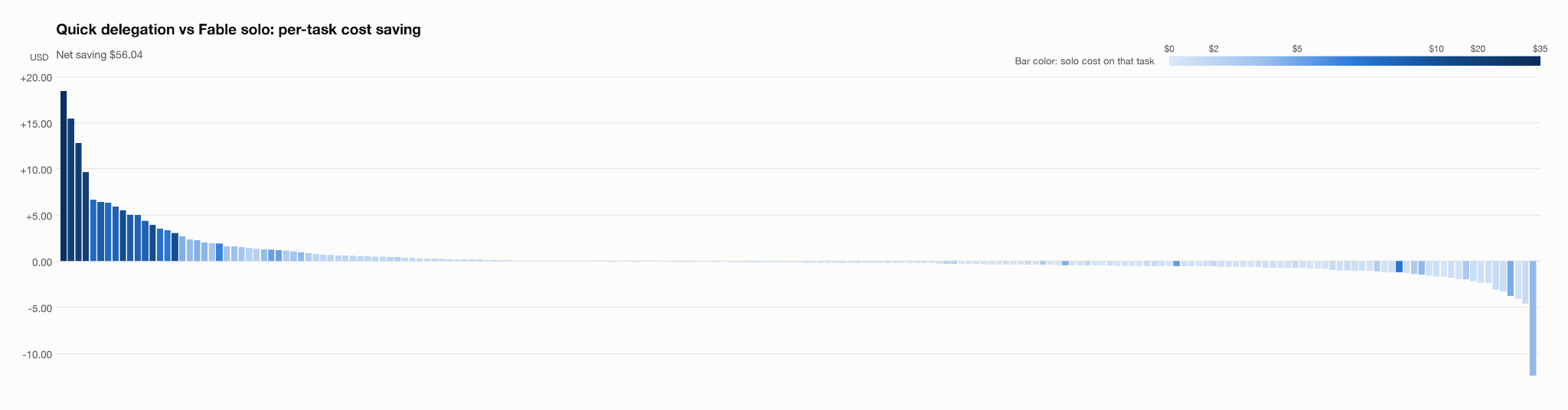
Immediately, the darker hue of the far left is very eye-catching. We can see that the far left (where the savings live) is much darker, while the far right (losses) is lighter. This indicates that on more expensive Solo tasks, the quick orchestration strategy saved a lot of money, while on less expensive tasks, the quick strategy tended to result in losses relative to Fable solo.
This difference is statistically significant. The average cost per task from the most expensive 10% of tasks2 is $11.22 for Fable solo, compared to Fable Quick’s $6.62, and the 95% confidence interval for savings is [-$7.41,-$1.68]. With bootstrapping, the interval gives Fable Quick orchestration savings of between 54% and 19%; the observed mean is 41% savings in the top 10% most expensive tasks.
Relatedly, overall, the quick orchestration strategy reduced task cost variance, with the confidence interval excluding zero.
Actionable insights?
Don’t assume the team beats the individual. Evaluate the team and coordination policies.
Overall, agentic setups are very sensitive to a number of factors, especially with subagents thrown into the mix. Behaviors and performances vary significantly by prompt wording, model, and task nature. We found that some orchestration strategies can shine in some settings, but orchestration is still far from being a clear, perfect win over solo models in general; thus, in determining the best policy to use in some situation, it is essential to evaluate different subagent setups and instructions within that specific environment before taking the plunge.